Scissor Skills Worksheets
Make cutting practice sheets with straight, zigzag, wavy and curvy lines, cut-out shapes and pictures. Choose what to practice, then print or save a PDF.
Customize
More options
The preview updates as you change the settings.
Why cutting practice helps
Cutting looks simple, but it asks a lot of a small hand. One hand holds and turns the paper while the other opens and closes the scissors, and the eyes follow the line the whole time. Regular practice builds the small muscles of the hand and trains hand-eye coordination and the habit of using two hands for different jobs. Those are the same skills a child draws on later to hold a pencil and write.
How to use the generator
- Choose a worksheet type: cutting lines, shapes or pictures.
- For lines, pick the kinds you want. For shapes, choose from circles, squares, triangles and more, including a spiral. For pictures, choose one or more picture groups.
- Choose how many items go on a page. Fewer items means bigger lines and shapes, which are easier for beginners.
- Press Generate new worksheet, then print the sheet or save it as a PDF. Every sheet is different.
The line types
- Snips are short lines across a strip of paper. They are the very first cutting skill: one open-and-close of the scissors makes one cut.
- Straight lines teach the child to open, close and move the scissors forward in a steady rhythm.
- Zigzag lines add sharp turns, so the child learns to turn the paper rather than the scissors.
- Wavy and curvy lines ask for smooth, flowing control.
- Steps have square corners and are a good challenge for older children.
Each line starts at a green dot, and a red square marks where it ends. In the picture version, the line leads from one picture to a related one, such as a bee to a flower, which gives the cutting a small goal.
A simple order to follow
Children differ a lot, so treat these ages as a rough guide only. Many children start with snipping around two to three years old, then cut along straight lines, then curves and zigzags. Cutting out simple shapes such as circles and squares usually comes next, and shapes with corners and curves, like hearts and stars, are harder. Move on when the current step feels easy and fun, not when a particular birthday arrives.
Tips for parents and teachers
- Use child-sized scissors with rounded tips. Left-handed children need left-handed scissors, because ordinary ones are hard to cut with and hide the line.
- Show the “thumbs up” hold: thumb in the small loop, one or two fingers in the big loop, thumb pointing to the ceiling.
- Remind the child that the helper hand holds the paper, and that the paper moves, not just the scissors.
- Slightly thicker paper is easier to cut than very thin paper, but ordinary printer paper works well too.
- Keep sessions short, praise effort and always supervise young children with scissors.
If a child finds cutting very hard or becomes frustrated after plenty of gentle practice, mention it to their teacher or doctor. They can suggest more help, such as an occupational therapist.
Frequently asked questions
What age is scissor practice for?
Most children are ready to start snipping somewhere around two to three years old. Start with the Snips and Straight lines at four items per page, and move to curves and shapes when your child is confident. Every child develops at their own pace.
Do I need special paper?
No. Ordinary printer paper works. Slightly thicker paper, such as light card, is easier to cut and to hold for some children, but it is not required.
What about left-handed children?
They should use left-handed scissors, which are made so that the cutting edge and the line stay visible. The sheets work the same for both hands.
Why is there no answer key?
Cutting practice has no right or wrong answer. Cutting along the dashed line is the exercise, so the worksheets do not need a key.
Are the pictures copyrighted?
No. Every shape and picture is an original drawing made for KidsTracing. None is taken from a book, game or cartoon.
Can I print the worksheets in black and white?
Yes. The dashed lines are dark and clear in black and white. The pictures print in color on a color printer and in grayscale otherwise.
Free printable workbooks
Want a planned set instead of a single page? These free PDF workbooks use the same worksheets in a step-by-step order.
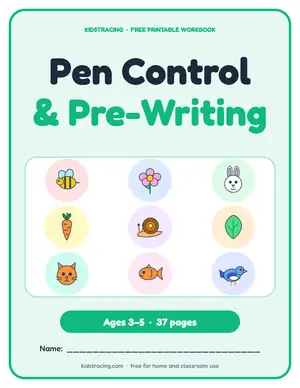
Pen Control and Pre-Writing Book
Lines, curves, zigzags, loops and spirals, plus paths from a bee to a flower, to build pencil control.
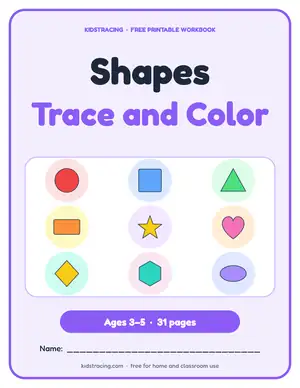
Shapes Tracing and Coloring Book
Ten shapes to trace, hunt for and color, plus tracing practice and matching games.
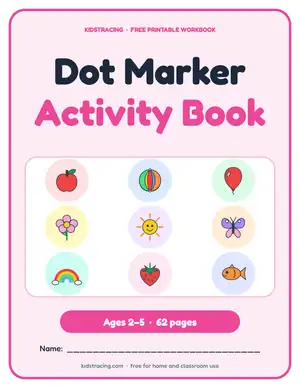
Dot Marker Activity Book
Big letters, numbers, shapes and pictures filled with circles for dot markers, stickers or fingertips.
Related worksheet tools
Explore more: Fine Motor Skills Worksheets · Preschool Worksheets · Kindergarten Worksheets · All free worksheet tools
Guides for parents and teachers: How to Teach a Child to Use Scissors · Handwriting Readiness Checklist: Is Your Child Ready to Write?