Pen Control and Pre-Writing Book: Free Printable Workbook (PDF)
A free 37-page pen control workbook for ages 3 to 5. Children trace straight lines, curves, waves, zigzags, loops and spirals, and follow fun paths such as a bee to a flower. Download the PDF in US Letter or A4 and print it at home or in class.
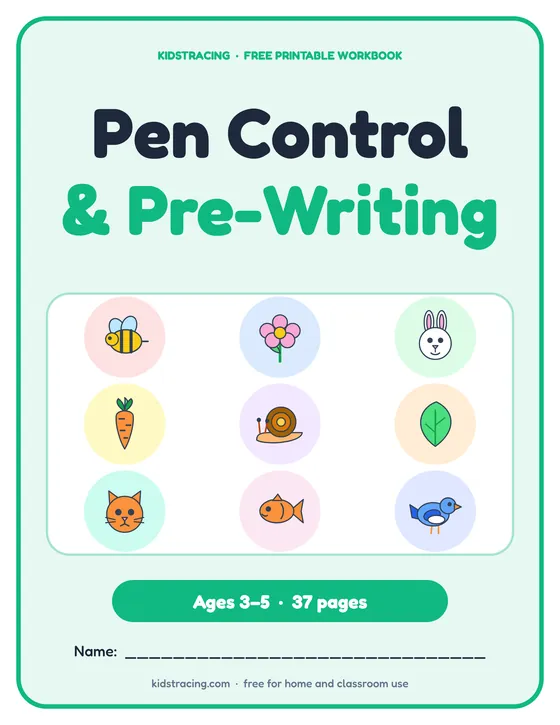
Download the Pen Control and Pre-Writing Book
- 37 pages for ages 3–5
- Free for home and classroom use, with no sign-up or email address
- Two PDF files: US Letter (8.5 × 11 in) and A4
- Prints in black and white or in color
Print at 100% (Actual size). Choose US Letter in the United States and Canada, and A4 almost everywhere else. How to print a workbook
Who this workbook is for
Before children can write letters they need to draw lines in several directions, make smooth curves and change direction on purpose. This workbook is for ages 3 to 5: toddlers who are just starting to make marks with a thick crayon will enjoy the path pages, while older preschoolers and pre-K children can move on to the Level Up pages.
The pages use the same patterns as our pre-writing worksheets, plus path pages that are only in this book. If you want to know which shapes children usually manage at which age, the guide on Pre-Writing Shapes by Age: When Can Kids Draw Each Shape? has a simple chart. When the lines feel easy, the ABC Tracing Book is the natural next step.
What is inside the Pen Control and Pre-Writing Book
The workbook has 37 pages. Every page is numbered in the bottom corner, so you can print one section at a time.
| Pages | Section | Number of pages |
|---|---|---|
| 1–3 | Cover, a page for parents and teachers, and the contents | 3 |
| 4–8 | Straight Lines | 5 |
| 9–16 | Curves and Waves | 8 |
| 17–24 | Zigzags, Castles and Loops | 8 |
| 25–28 | Spirals and Mixed Patterns | 4 |
| 29–36 | Level Up | 8 |
| 37 | Certificate of achievement | 1 |
Straight Lines (pages 4–8)
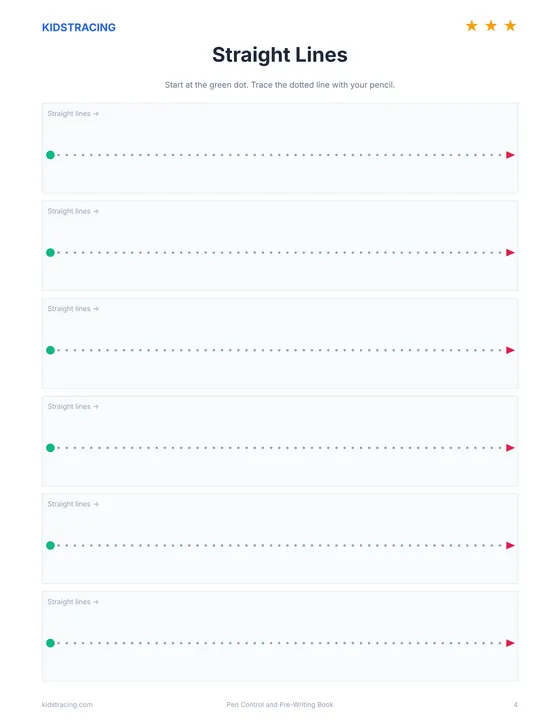
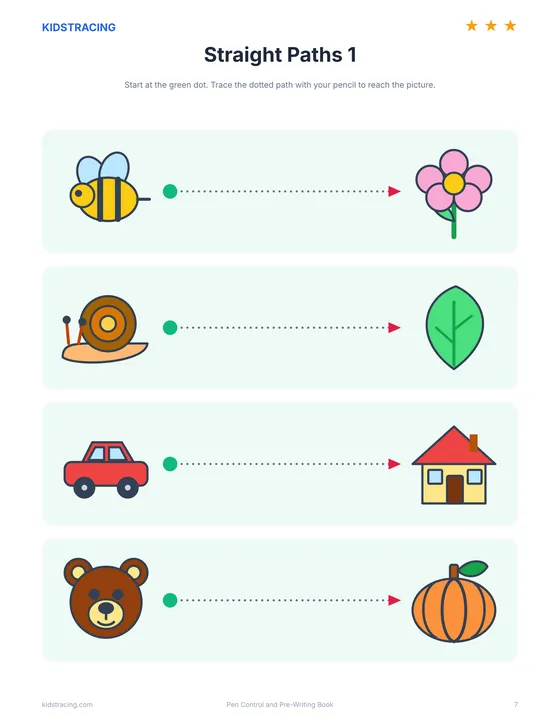
Three tracing pages (lines across, lines down and slanting lines) and two path pages. On the path pages each of four rows has a picture at each end, such as a bee and a flower, and a dotted straight line to trace from the green dot to the red arrow. Left-to-right and top-to-bottom are the directions we use for writing.
Curves and Waves (pages 9–16)
Bridges (arches) and wavy lines on the tracing pages, then six path pages: two with long curves, two with waves and two with round hills. The hill paths copy the arch movement that is later used for letters like m and n.
Zigzags, Castles and Loops (pages 17–24)
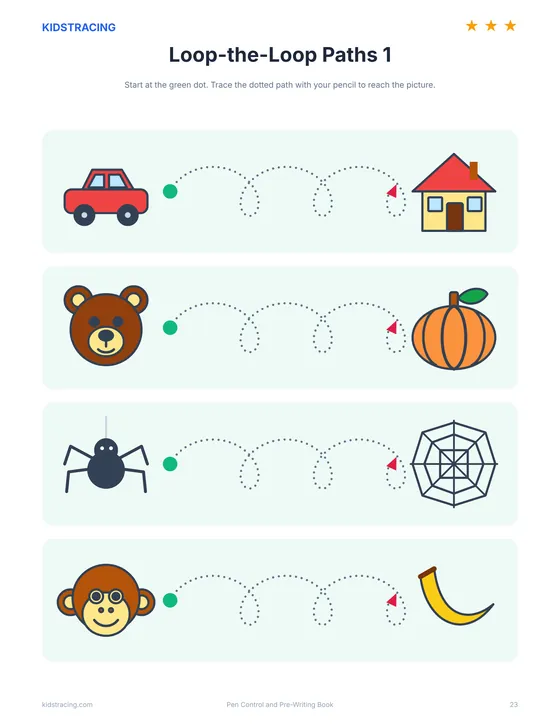
Zigzags need sharp changes of direction, loops are the movement behind many cursive letters, and the castle-wall paths have square steps that practice stopping, turning and going on, as in E, F and H. This is the longest section: eight pages in all.
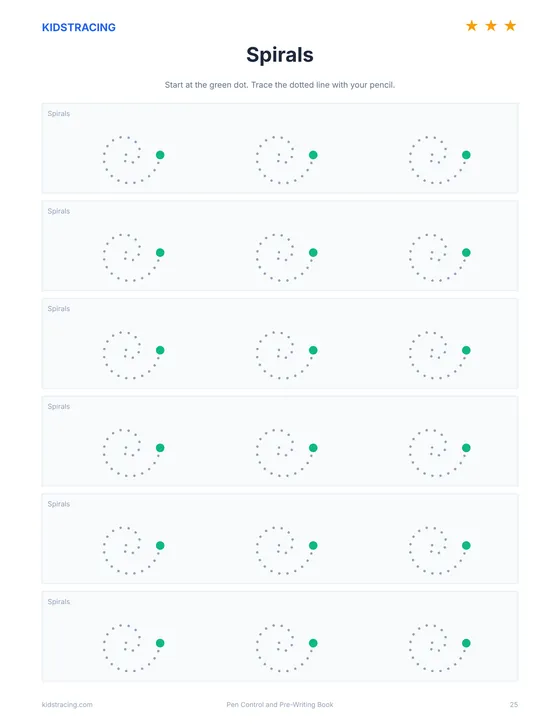
Spirals and Mixed Patterns (pages 25–28)
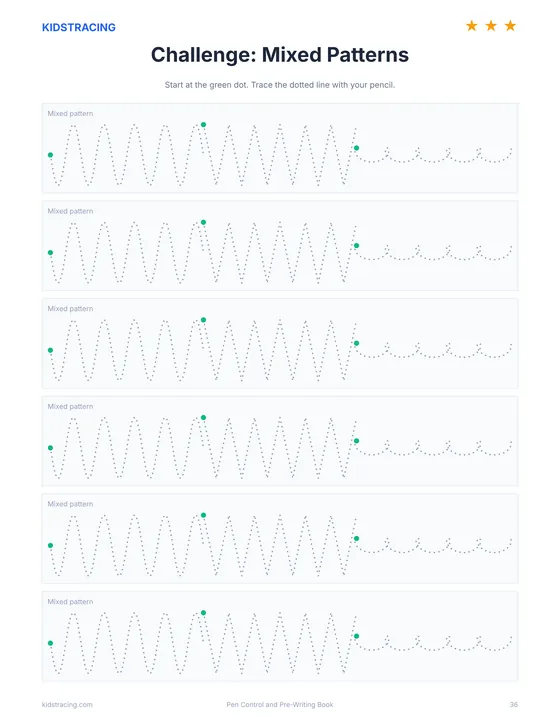
Spirals teach children to keep a curve going and to slow down as the circle gets tight. The mixed pattern page changes the pattern along each row, and the last two pages combine two kinds of line on one sheet (lines across and down, then bridges and waves), which is closer to the changes of direction in real handwriting.
Level Up (pages 29–36)
Eight pages for children who have mastered the first four sections. Four “Level Up” pages use smaller and tighter patterns, and four “Challenge” pages use tall waves, dense zigzags, loops and mixed patterns. Skip them for now if the earlier pages still feel hard.
Sample pages
A few pages from the finished workbook. The PDF is sharp enough to print at full size.
Skills your child practices
- Eye-hand coordination and smooth pencil movement
- Controlling the start, direction and stop of a line
- Left-to-right and top-to-bottom direction
- Curves, loops and angles used in letters
- Hand strength and stamina for longer writing
How to use this workbook
Print a few pages at a time
Choose US Letter or A4 and print at 100% (Actual size). Start with Straight Lines; a whole book at once can be too much.
Set up the body first
A chair that lets both feet touch the floor, a table at elbow height and the free hand holding the paper still make the pencil easier to steer.
Start at the green dot
Always begin at the green dot and finish at the red arrow. Say “ready, go, stop” to turn it into a game.
Use a fat pencil or a short crayon
A short, thick crayon encourages a good grip in small hands. Move to a pencil when lines are steady.
Repeat, don’t perfect
The same page on another day is better practice than a new page on the same day. Keep early attempts to compare progress.
When lines come out wobbly
Wobbly lines at this age are normal. Slow down, shorten the session, and check posture and grip before blaming the page. Many children draw straighter lines when they trace the pattern with a finger first and say the direction out loud.
If your child avoids pencil work, try the same patterns with other tools: chalk on the pavement, a finger in a tray of sand or a paintbrush with water. The Handwriting Readiness Checklist: Is Your Child Ready to Write? lists other signs that a child is ready for the next step.
Free worksheet generators to go with this workbook
Every page in the workbook was made with the same tools you can use yourself. Use them to print extra practice with your own words, names or numbers.
Pre-Writing Lines
Lines, curves, waves, loops and spirals at three levels.
Preschool Line Tracing
Straight, slanted and curved lines for beginners.
Curves, Waves and Loops
Bridges, waves, loops and spirals to trace.
Shape Tracing
Dotted or solid shapes, names and a coloring strip.
Scissor Skills
Cutting practice: lines, zigzags, curves, shapes and pictures.
Guides for parents and teachers
Pre-Writing Shapes by Age: When Can Kids Draw Each Shape?
The pre-writing shapes in order, with the usual age children can copy each one: line, circle, cross, square, diagonals and triangle, and how to practice.
Pre-Writing Activities for Preschoolers: 15 Fun Ideas
Fifteen fun pre-writing activities for preschoolers that build the strokes, strength and control children need before they start writing letters and names.
Handwriting Readiness Checklist: Is Your Child Ready to Write?
A simple handwriting readiness checklist for ages 3 to 6: ten signs your child is ready to start writing, and what to do if they are not there yet.
More free printable workbooks
ABC Tracing Book
Every letter A to Z with numbered stroke arrows, a picture to color and a word to trace.
Shapes Tracing and Coloring Book
Ten shapes to trace, hunt for and color, plus tracing practice and matching games.
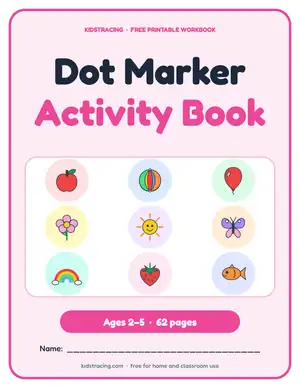
Dot Marker Activity Book
Big letters, numbers, shapes and pictures filled with circles for dot markers, stickers or fingertips.
Frequently asked questions
Is the Pen Control and Pre-Writing Book free?
Yes. It is free for use at home and in the classroom, with no sign-up or email. Print as many copies as you need for your own children or students, but please do not sell the file or host it elsewhere.
At what age can children use it?
Most children enjoy the first pages from about age 3, but every child is different. There is no pass or fail: if a page is too hard, go back one section and try again in a few weeks.
Should my child use a pencil or a crayon?
Either. A short, thick crayon is often easier for small hands, and a regular pencil is fine once the grip feels steady. Avoid markers that bleed through the paper on the path pages.
What about left-handed children?
The pages are the same for everyone. Left-handed children often write more comfortably with the paper tilted to the right and the hand below the line, so they do not smudge or hide what they have written.
Do we have to start at the beginning?
It helps. The sections run from the simplest movement (straight lines) to harder ones (loops, spirals and mixed patterns), so starting at the beginning avoids frustration.