Cursive Handwriting Workbook: Free Printable Cursive Practice (PDF)
A free 71-page cursive handwriting workbook for ages 6 to 9. It has one page for each of the 26 small letters and 26 capital letters, two alphabet review pages, ten pages of cursive words, days and months, and three pages of sentences. Download the PDF in US Letter or A4 and print it at home or in class.
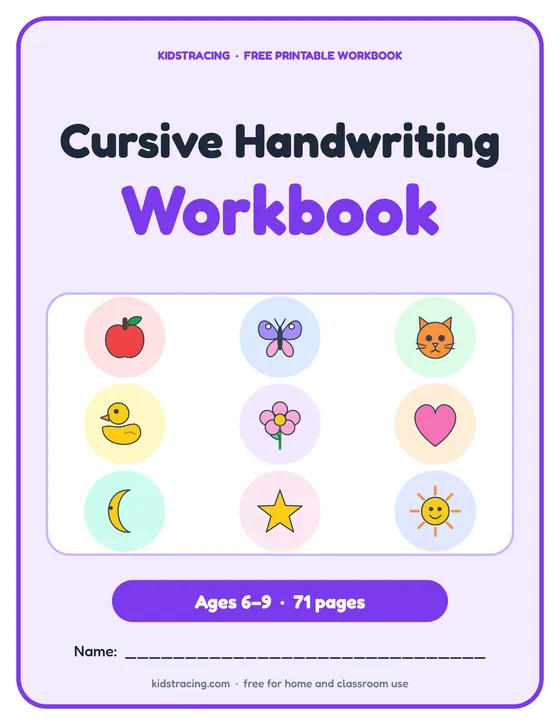
Download the Cursive Handwriting Workbook
- 71 pages for ages 6–9
- Free for home and classroom use, with no sign-up or email address
- Two PDF files: US Letter (8.5 × 11 in) and A4
- Prints in black and white or in color
Print at 100% (Actual size). Choose US Letter in the United States and Canada, and A4 almost everywhere else. How to print a workbook
Who this workbook is for
Many US schools introduce cursive in second or third grade, after children are secure in print writing, and families who homeschool often start at the same age. This workbook is for ages 6 to 9, for children who can write their print letters on the line and want to learn joined writing, and for older children who need a fresh start.
It teaches cursive in the order the page numbers run: small letters first, then capitals, then whole words and sentences. If your child is not yet comfortable forming print letters, begin with the ABC Tracing Book or the CVC Words Workbook. To practice a name or a list of your own words, use our cursive writing worksheets or our cursive name tracing page, and read the How to Teach Cursive Handwriting to Kids guide for a gentle teaching plan.
What is inside the Cursive Handwriting Workbook
The workbook has 71 pages. Every page is numbered in the bottom corner, so you can print one section at a time.
| Pages | Section | Number of pages |
|---|---|---|
| 1–3 | Cover, a page for parents and teachers, and the contents | 3 |
| 4–16 | Small Letters a to m | 13 |
| 17–29 | Small Letters n to z | 13 |
| 30–42 | Capital Letters A to M | 13 |
| 43–55 | Capital Letters N to Z | 13 |
| 56–57 | Alphabet Review | 2 |
| 58–67 | Cursive Words | 10 |
| 68–70 | Cursive Sentences | 3 |
| 71 | Certificate of achievement | 1 |
Small Letters a to m (pages 4–16)
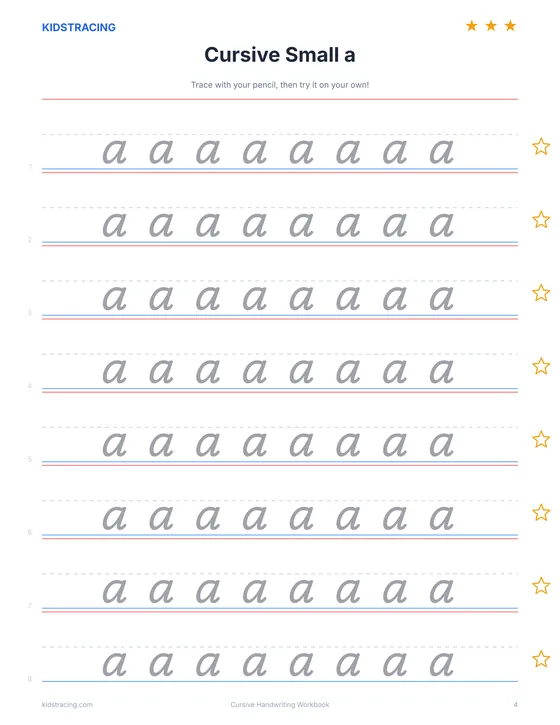
Thirteen pages, one letter per page. Each page has eight lines of the same small letter in light gray on handwriting paper with a dotted middle line and a baseline, so your child can trace the shape again and again. Letters a, c, d, g and q all start with the same round “c” stroke, so they are good ones to group together.
Small Letters n to z (pages 17–29)
Thirteen more pages from n to z. This group has the letters with the most unusual shapes (r, s, v, x, z) and long descenders (p, q, y, z), which go below the baseline. Take them slowly and compare each letter with the one before it.
Capital Letters A to M (pages 30–42)
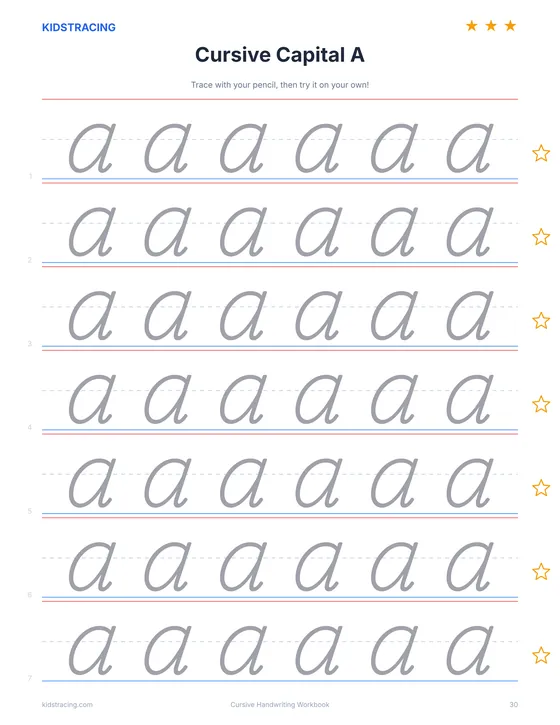
Thirteen pages of capitals, one per letter, with six large letters on each of seven lines. Capitals stand taller than the small letters, so each line is a little roomier. Capitals follow a traditional American cursive model, and some, such as M and N, look like taller versions of their small letters with an extra starting stroke.
Capital Letters N to Z (pages 43–55)
The last thirteen capitals, N to Z. Some of these, such as Q and Z, look quite different from their print versions, so ask your child to say the letter name out loud as they trace each one.
Alphabet Review (pages 56–57)
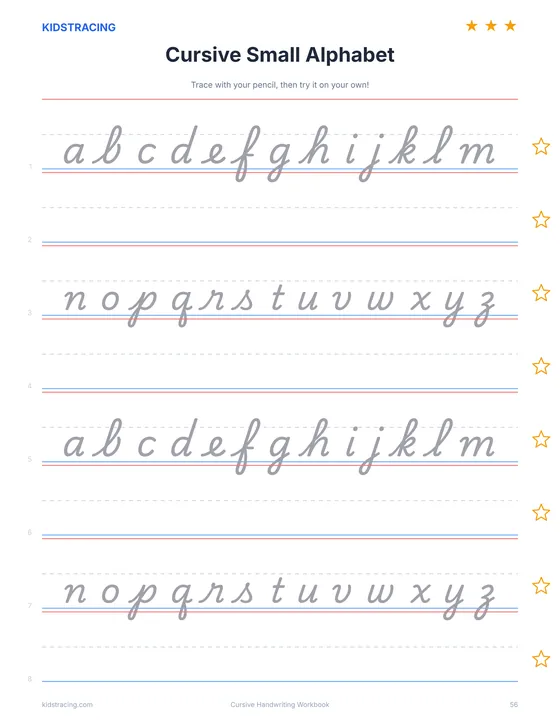
Two pages that show the whole small alphabet (a to m and n to z) and the whole capital alphabet. Each alphabet appears twice in light gray, and a blank line beneath every gray row gives your child space to write it alone. They are a good checkpoint before starting words.
Cursive Words (pages 58–67)
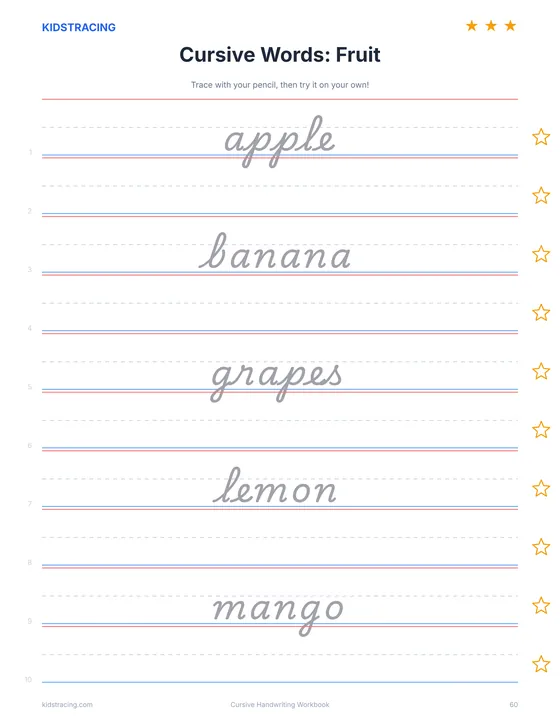
Ten pages of five words each, with every word shown once in light gray to trace and a blank line beneath for your child to write it alone. The topics are sky and feelings, animals, fruit, colors, family, the days of the week (two pages) and the months of the year, with the four seasons at the end. The letters inside each word are joined, which is the main skill of cursive.
Cursive Sentences (pages 68–70)
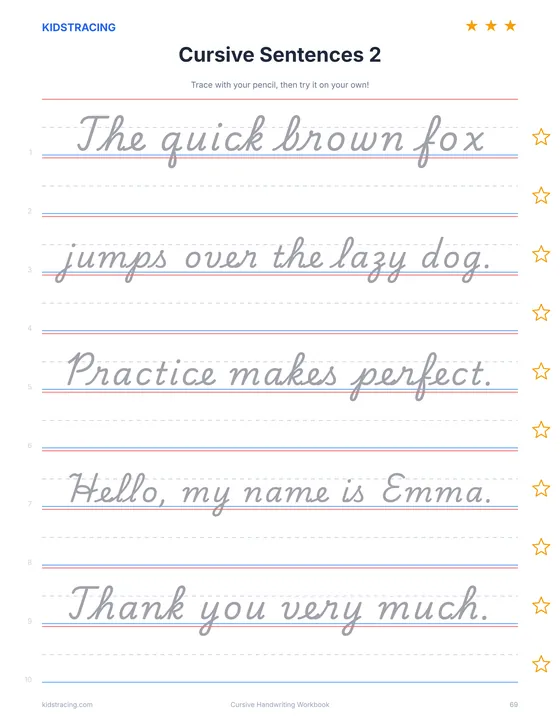
Three pages of five short sentences each, from “The sun is bright.” to “Smile and be happy.” One is the pangram “The quick brown fox jumps over the lazy dog.” (split over two lines), which uses every letter of the alphabet. Each sentence is shown in light gray to trace, with a blank line below to write it again.
Sample pages
A few pages from the finished workbook. The PDF is sharp enough to print at full size.
Skills your child practices
- Forming all 26 small and 26 capital cursive letters
- Writing with a smooth, slanted, flowing stroke
- Joining letters inside words
- Keeping letters on the baseline and at the right height
- Writing the days, the months and short sentences
How to use this workbook
Print and set up the workspace
Choose US Letter or A4 and print at 100% (Actual size). Sit with both feet on the floor and tilt the paper slightly: to the right for right-handers and to the left for left-handers.
Start with a few small letters
Pick two or three letters that start the same way, such as a, c and d. Trace one page of each, then repeat the next day. There is no need to do all 13 in a week.
Trace slowly and say the stroke
Say “up, over, down” or any simple phrase as the pencil moves. Smooth is better than fast, and children should not lift the pencil in the middle of a letter unless the model does.
Move on to capitals and words
Once the small letters feel comfortable, add the capitals, then the word pages. Words are where cursive begins to make sense, because the letters join.
Write something real
After each page, ask your child to write a name, a shopping list item or a short note in cursive. A real reason to write makes the practice stick.
Cursive styles differ from school to school
There is no single cursive style. Schools in the United States use several models, including D’Nealian, Zaner-Bloser and Palmer, and the shapes of some capitals vary between them. This workbook uses one traditional, slightly slanted style throughout. If your child’s school uses another model, check the capitals with the teacher and treat this book as extra practice for the movement and the joins.
Short, daily practice works much better than a long weekly session. Ten minutes a day is plenty, and the Cursive Letters A to Z: A Simple Guide for Kids and Cursive Practice Sentences for Kids: Easy to Hard List guides explain how to move from letters to sentences. To learn the most important word of all, see how to How to Write Your Name in Cursive.
Free worksheet generators to go with this workbook
Every page in the workbook was made with the same tools you can use yourself. Use them to print extra practice with your own words, names or numbers.
Guides for parents and teachers
How to Teach Cursive Handwriting to Kids
A step-by-step guide to teaching cursive handwriting to kids, with a four-week practice plan and tips for creating cursive worksheets for free.
Cursive Letters A to Z: A Simple Guide for Kids
A simple guide to cursive letters A to Z for kids: lowercase letter groups, joins, capitals, tricky letters and a practice plan with free printable sheets.
Cursive Practice Sentences for Kids: Easy to Hard List
A list of cursive practice sentences for kids, from easy to hard, with tips for choosing sentences and making your own cursive worksheets for free.
How to Write Your Name in Cursive
Learn how to write your name in cursive with simple tips, letter groups and ideas for custom cursive names, plus a free generator to practice.
More free printable workbooks
CVC Words Workbook
Read, build, trace and write short a, e, i, o and u words with pictures, sound boxes and sentences.
ABC Tracing Book
Every letter A to Z with numbered stroke arrows, a picture to color and a word to trace.
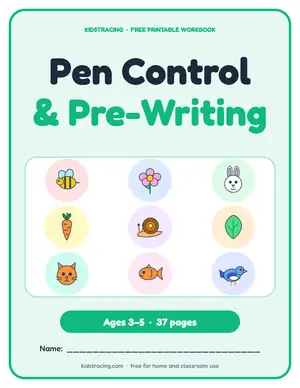
Pen Control and Pre-Writing Book
Lines, curves, zigzags, loops and spirals, plus paths from a bee to a flower, to build pencil control.
Frequently asked questions
Is the Cursive Handwriting Workbook free?
Yes. It is free for home and classroom use and needs no sign-up. Print as many copies as you need for your own children or students. Please do not sell the file or host it on another website.
Which cursive style does the workbook use?
A traditional, slightly slanted American cursive style (the Playwrite US Trad font). It is not D’Nealian and not Zaner-Bloser, so some capital letters may look different from the model used in your child’s school.
At what age should children learn cursive?
Many US schools start cursive in second or third grade, at about age 7 to 9. Children need to be confident with print first, so there is no need to hurry.
Where are the blank lines for writing alone?
The letter pages are all tracing, to build the shape and the movement. The word and sentence pages include a blank line beneath every gray word or sentence so that children can write it alone.
Can I make a page with my own words or name?
Yes. Our cursive writing worksheets let you type any text, and our cursive name tracing page makes name practice sheets.